


Have you ever calculated how much you spend per year on sauna sessions at a gym or spa? For most people, the answer is enough to justify purchasing their own sauna. A home sauna is no longer a luxury reserved for mansions with swimming pools; it has become an accessible reality for those who practice sports regularly, value active recovery, and want to control their own wellness protocol without relying on schedules or shared spaces. In this guide, you will find everything you need to make an informed decision: types, real benefits (supported by research), installation requirements, costs, and how to integrate a sauna into a complete recovery routine.
Table of Contents
- Quick Summary
- Why Have a Home Sauna?
- Types of Saunas for Home Use
- Sauna Benefits: What Research Says
- Sauna and Sports Recovery
- What You Need to Know Before Installing
- Comparison Between Sauna Types
- Frequently Asked Questions
- References
Quick Summary
| Key Idea | Explanation |
|---|---|
| The Finnish sauna is the highest temperature option | Operates between 80°C and 100°C with low humidity. Ideal for those who tolerate heat well and want the experience closest to Nordic tradition. |
| The infrared sauna is more affordable and easier to install | Functions between 40°C and 60°C and heats the body from the inside out. It requires no construction work or three-phase power in most home models and is the most popular for home use. |
| Regular sessions have proven cardiovascular impact | Long-term studies show that frequent sauna users have a lower risk of mortality from cardiovascular diseases compared to occasional users. |
| The portable sauna is the most practical entry point | No construction, no dedicated space, and no special electrical installation. Ideal for testing the habit before investing in a fixed model. |
| Combining sauna with cold plunge boosts recovery | Contrast therapy (alternating heat and cold) is used by elite athletes to reduce inflammation and accelerate muscle recovery. |
| Maintenance is simple but cannot be neglected | Cleaning after each session, proper ventilation, and periodic checks of the heating equipment ensure longevity and hygiene. |
| A sauna adds value to the property | Beyond the health benefits, installing a home sauna is considered a real asset for a home's market value. |
Why Have a Home Sauna?
The honest answer is this: a home sauna works because it removes friction. When the equipment is in your own space, the likelihood of using it regularly increases significantly. No travel, no queues, no closing times. Consistency is what turns a pleasant experience into a recovery protocol with real results.
For athletes, runners, cyclists, and fitness enthusiasts with frequent training sessions, immediate access to heat after a workout translates into fewer days of muscle soreness and better sleep quality. For those working in high-pressure environments, a home sauna becomes an unprecedented decompression ritual: 20 minutes of controlled heat activates the parasympathetic nervous system and breaks the cycle of elevated cortisol that accumulates throughout the day.
Tip: If you don't have an established sauna habit yet, start with a portable sauna before investing in a fixed model. The goal is to figure out how often you actually use it before committing space and budget to a permanent installation.

Types of Saunas for Home Use
There isn't just one type of sauna. The right choice depends on your available space, heat tolerance, budget, and health goals. Knowing the differences before buying saves you frustration and money.
Finnish Sauna (Traditional)
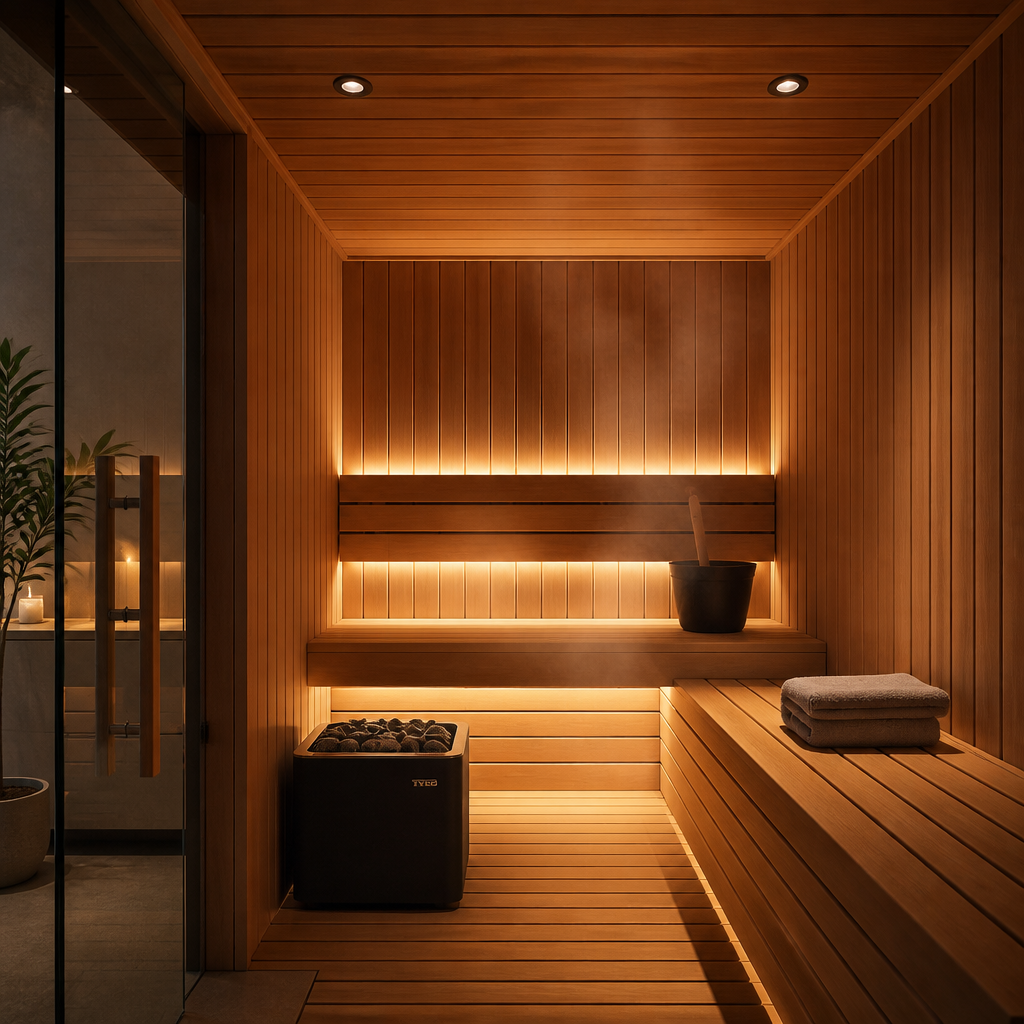
This is the most classic and recognized form. It heats the environment to between 80°C and 100°C using a volcanic stone stove. Humidity is low (between 5% and 20%), but can increase momentarily when water is poured over the stones. The body warms up gradually as you breathe in the hot air. It is the most intense experience and requires a more robust installation, often including three-phase electrical connections for larger home models.
Infrared Sauna
Uses infrared radiation emitters that penetrate directly into body tissues, up to about 3 to 4 centimeters deep, without needing to heat the air to the same level as a traditional sauna. It operates between 40°C and 60°C, making the experience milder and more accessible for those with lower tolerance for intense heat. It is the most popular option for home installation: it requires no major construction, compact models plug into standard outlets, and heating is faster.
Turkish Bath (Hammam)
Works with high-humidity steam. Temperatures range between 40°C and 60°C, but the sensation is very different from a dry sauna due to steam saturation. It requires total waterproofing of the space and a continuous steam generation system. It is less common in individual home installations but can be integrated into bathrooms of appropriate size.
Portable Sauna
The most affordable entry-level solution. It takes up no permanent space, requires no special electrical installation, and can be assembled and disassembled in minutes. It generally works with steam and reaches temperatures between 40°C and 50°C. It is ideal for those who want to experience the benefits of a sauna without the commitment of construction or a dedicated space. Alaska Recover, for example, includes portable solutions in their catalog precisely for this user profile.
Sauna Benefits: What Research Says
The benefits of the sauna are not just Nordic folklore. There are published studies that have followed populations of regular users for years, and the results are consistent enough to merit serious attention.
Cardiovascular Health
During a sauna session, the heart rate increases in a controlled manner, in an effect often described as a "mini" cardiovascular workout without the physical exertion of exercise. Long-term studies show that frequent sauna users have a lower risk of mortality from cardiovascular diseases compared to those who use it rarely. A Finnish study that followed over 2,300 men concluded that those who used a sauna 4 to 7 times per week had a significantly lower risk of dying from heart disease compared to occasional users. This effect is attributed to improved endothelial function and reduced blood pressure with regular use.
Stress Reduction and Improved Sleep
The sauna stimulates the parasympathetic nervous system, helping the body move out of an alert state and into a recovery state. Research published in the Journal of Human Hypertension found lower cortisol levels in participants after sauna sessions. Less cortisol means less pressure on the cardiovascular system and, in practice, better sleep quality and lower accumulated anxiety.
Detoxification and Skin Health
Intense sweating is the body's natural mechanism for eliminating metabolic waste. Sauna sessions create the ideal conditions for this process, opening pores and stimulating deep sweating that is hard to achieve with normal exercise. The result is cleaner skin, better peripheral circulation, and a sense of physical lightness that most regular users describe as addictive.
Regular, controlled heat is one of the most underrated tools in preventive medicine. The problem isn't the evidence; it's that people don't believe something so simple can have such a wide-ranging impact.
Immune System
Regular heat exposure stimulates the production of heat shock proteins, which play a significant role in immune response and cellular repair. Regular sauna users report a lower frequency of colds and respiratory infections, which is consistent with known biological mechanisms, although research in this specific area is still evolving.

Sauna and Sports Recovery
For athletes and those who practice intense sports, the sauna is a recovery tool with a clear logic: heat increases blood flow to muscles and joints, delivering oxygen and nutrients while removing metabolic waste products like lactic acid. The practical result is less muscle soreness in the days following demanding workouts.
Combining sauna with an ice bath, known as contrast therapy, is the preferred protocol for many elite athletes. Heat dilates blood vessels and promotes circulation; cold constricts them and reduces acute inflammation. Alternated in a controlled manner, the two stimuli create a "vascular pumping" effect that accelerates recovery in a way neither treatment can match on its own.
At Alaska Recover, this is precisely the principle behind the combined offering of saunas and ice baths: it's not about choosing heat or cold; it's about using both intelligently to maximize recovery between training sessions. If you are a long-distance weekend runner, a cyclist, or a triathlete, this protocol can change how you feel on Monday morning.
Tip: For contrast therapy at home, always end with a cold immersion after your sauna session. Start with 15 to 20 minutes in the sauna and transition immediately to an ice bath or a 2 to 3-minute cold shower. Repeat for 2 to 3 cycles as tolerated. Stay well-hydrated before and after.
What You Need to Know Before Installing
Installing a home sauna is not as complex as it seems, but there are practical requirements you may not have considered that determine whether the project will proceed without surprises.
Space and Sizing
Correct space sizing is critical. An undersized space for the chosen heating equipment results in performance failures and discomfort; an oversized space means inefficient energy consumption. For a one to two-person sauna, 1.2m x 1.2m is generally the functional minimum. The ceiling should be low enough to keep heat concentrated, typically between 1.9m and 2.1m.
Electrical Installation
Larger domestic Finnish saunas require a three-phase electrical installation. More compact infrared models work with normal single-phase current, which significantly simplifies installation. Before buying, check the equipment's rated power and confirm with an electrician what is required for your home.
Ventilation and Insulation
A sauna without proper ventilation is a hygiene and health issue. You need a fresh air intake near the floor and a hot air exhaust at the top to ensure circulation and prevent the buildup of excessive steam that fosters mold growth. Thermal insulation of the walls is equally important for energy efficiency.
Recurring Maintenance
Maintenance of a wooden sauna is simple but cannot be ignored. After each session, cleaning the benches and backrests with a brush is the bare minimum. Periodically, lightly sanding the wooden seats keeps the surface smooth and less susceptible to bacteria buildup. Harsh detergents damage the wood; always use specific sauna products or diluted hydrogen peroxide disinfectant for deeper cleaning. After each use, leave the door open to promote drying.
Comparison Between Sauna Types
| Features | Finnish Sauna | Infrared Sauna | Portable Sauna |
|---|---|---|---|
| Operating temperature | 80°C to 100°C | 40°C to 60°C | 40°C to 50°C |
| Humidity | Low (5% to 20%) | Very low | Medium to high (steam) |
| Installation required | Construction and three-phase electricity (often) | Single-phase connection for most compact models | No construction. Standard outlet |
| Space required | Permanent dedicated space | Permanent dedicated space | Any room with minimal space |
| Heating time | 30 to 60 minutes | 10 to 20 minutes | 10 to 15 minutes |
| Initial investment | Higher | Medium to high | Most affordable |
| Ideal for | Intense traditional experience, frequent users | Regular home use, lower tolerance for extreme heat | Beginners, limited spaces, occasional use |
| Maintenance | Regular cleaning of wood and stones | Cleaning of emitters and interior | Simple, washing the cover |
Frequently Asked Questions
What is the most suitable type of sauna to install in an apartment?
The infrared sauna is the most practical option for apartments. It requires no structural work, compact one or two-person models plug into standard single-phase outlets, and heating time is short, which reduces energy consumption per session. If space is very limited, a portable sauna is the most immediate alternative with no installation commitment.
How many times per week should I use the sauna to get real benefits?
Existing research points to increasing benefits with frequency. Three or more sessions per week appear to be the threshold where cardiovascular and recovery effects become more consistent. For post-workout sports recovery, one session the day after an intense workout already produces noticeable differences in muscle soreness and mobility.
Is a home sauna safe for people with high blood pressure or heart problems?
This is a question that requires individual medical consultation before any decision. In general, studies show that moderate sauna use can be beneficial for cardiovascular health in healthy individuals, but in cases of uncontrolled hypertension, arrhythmias, or other heart conditions, prior evaluation by a doctor is essential. Never start a regular sauna protocol based solely on online readings if you have a known cardiovascular history.
What is the practical difference between an infrared sauna and a Finnish sauna for muscle recovery?
Both promote increased blood flow and help remove muscular metabolic waste. The difference lies in how heat is delivered to the body. In an infrared sauna, radiation penetrates directly into the muscle tissues, which many users describe as a deeper heat sensation even at lower air temperatures. In a Finnish sauna, the heat is more intense and peripheral initially, but equally effective with well-structured sessions. For those who cannot tolerate temperatures above 70°C, infrared is clearly the best recovery option.
How to integrate a sauna with an ice bath into a home recovery routine?
The most common protocol is: 15 to 20 minutes in the sauna, followed by 2 to 3 minutes of cold water immersion or an ice bath, with a recovery period at room temperature between cycles. You can repeat this for 2 to 3 cycles, depending on your tolerance. Alaska Recover provides both saunas and ice tubs as well as water chillers for those who want to set up a complete contrast therapy system at home, without relying on external facilities.
Does a portable sauna provide the same benefits as a fixed sauna?
For most general benefits, a portable sauna is a valid and functional alternative. The main limitation is the maximum temperature reached, which rarely exceeds 50°C, and the fact that the face remains outside the steam chamber in most models. For those just looking for the benefits of relaxation, detoxification, and light muscle recovery, it works well. For more intense protocols or frequent users who want to maximize cardiovascular effects, a fixed model is the better upgrade.
What is the maintenance for a wooden sauna at home?
The basic routine is simple: clean the benches and the floor after every session, always leave the door open at the end to thoroughly dry the interior, and avoid harsh detergents that damage the wood. Once a year, light sanding of the seats renews the surface and reduces bacteria buildup. For deeper cleaning, use sauna-specific products or a highly diluted hydrogen peroxide-based disinfectant. With this maintenance, a quality sauna will last for decades.
Do you already have a sauna at home, or are you considering installing one? Tell us about your experience or share your questions in the comments; your perspective helps other readers make the right decision.
References
- Complete guide to the benefits of installing a home sauna
- What science says about sauna and cardiovascular health
- 5 advantages of the sauna to boost your sports training
- Differences between infrared saunas and traditional Finnish saunas
- Types of saunas and pricing information for the Portuguese market