


The question we receive most from athletes and wellness enthusiasts is straightforward: what does it really cost to have an ice bath at home? The honest answer is that it depends on the setup you choose, and the difference between the cheapest and most premium options can be several thousand euros. What few people analyze rigorously is the actual return on this investment over time. When you compare the cost per session of your own system with what you spend on recovery outside the home, physical therapy, and lost time, the calculation changes completely. This guide details each component of the cost of an ice bath and helps you decide which level of investment makes sense for your case.
Table of Contents
- Quick Summary: What You Need to Know
- Setup Types and Price Ranges
- Monthly Operating Costs: Electricity, Water, and Maintenance
- Actual Cost per Session Over Time
- Comparison Between Setups
- The ROI of an At-Home Ice Bath
- Most Common Mistakes When Calculating Cost
- Frequently Asked Questions
- References
Quick Summary: What You Need to Know
| Key Idea | Explanation |
|---|---|
| Initial cost varies widely | A basic portable tub can cost less than 100 euros, while an integrated system with a professional chiller exceeds 3,000 euros. The right type depends on your frequency of use and your temperature requirements. |
| Cost per session drops over time | With regular use of 3 to 5 times per week, a chiller system can cost less than 2 euros per session after 12 months, much less than any session at an external clinic. |
| Purchased ice is more expensive than it looks | Buying ice regularly to maintain the correct temperature adds up to a significant monthly cost and is impractical in the long run. A chiller solves this once and for all. |
| Electricity is not the biggest cost | A well-insulated home chiller consumes about 15 to 40 euros per month in electricity. This amount is often less than what is spent on a single physical therapy or clinical cryotherapy session. |
| Thermal insulation determines efficiency | A quality-insulated tub maintains temperature for longer and reduces the chiller's effort, directly cutting monthly electricity costs. |
| The ideal frequency is 2 to 4 sessions per week | Studies indicate that 11 minutes of deliberate cold exposure spread throughout the week provides concrete recovery benefits, making a home system highly cost-effective. |
| ROI is not just financial | Shorter recovery time, fewer injuries, better sleep quality, and more training consistency translate into results that no cost calculator can fully capture. |
Before getting into the detailed numbers, it is worth making one point clear: there is no universally correct setup. What exists is the right setup for your profile, your training volume, and your available space. The following sections will help you identify it with precision.
Setup Types and Price Ranges
There are three major categories of home ice bath setups, each with a different cost profile and value proposition. Knowing the real differences between them is the first step to avoiding wasting money.
Portable Tub Without Chiller
The most affordable entry into the home cryotherapy world. These tubs, usually made of PVC or neoprene with basic insulation, cost between 80 and 400 euros. The real problem isn't the initial price, but the hidden operating cost: you need to buy or make ice for every session. To maintain water between 10 and 15 degrees in a typical session, you need several kilos of ice. Done frequently, this cost adds up quickly.
This type of setup works well for those testing the practice or who have easy access to plenty of ice. For consistent use 3 to 5 times per week, it becomes impractical and more expensive than it first appears.
Portable Tub with Mini Chiller
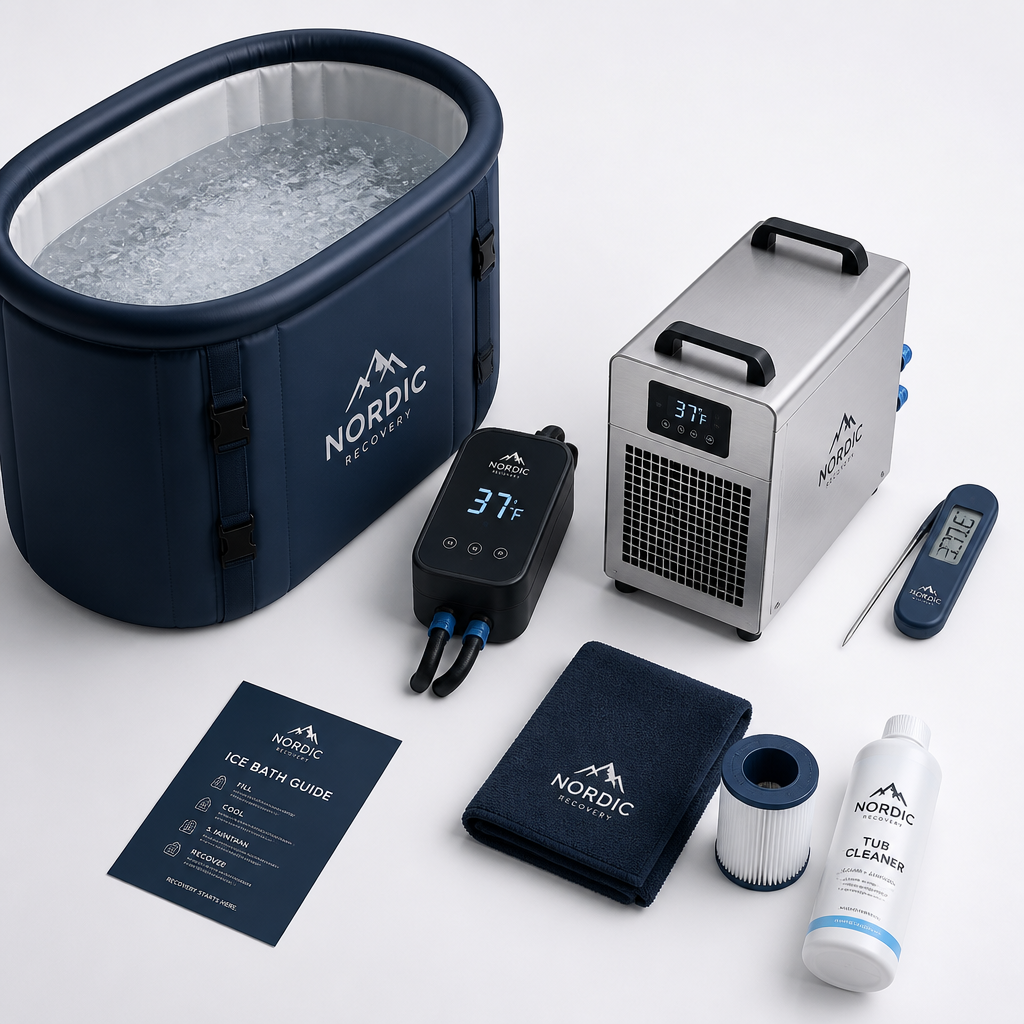
This is the most balanced entry point for serious users. The combination of a well-insulated tub and a compact chiller eliminates the dependency on ice and allows for precise temperature control. The initial cost for this setup is typically between 1,000 and 2,500 euros, depending on the tub's capacity, the chiller's power, and included features like water filtration and remote control via a mobile app.
The Alaska Recovery DUO PRO with Mini Chiller, for example, is designed for those who want to start recovering seriously without complex construction or installations. It keeps the water cold continuously, without needing to add ice, and can be controlled directly from a smartphone.
Tip: When comparing chillers, always check the HP rating and the recommended maximum water capacity. An undersized chiller for your tub's volume will consume more electricity and struggle to maintain low temperatures on hot days.
Professional Integrated System with High-Power Chiller
For those who train with high intensity, have a dedicated recovery space, or manage a studio, gym, or clinic, integrated systems with rigid structures, thick insulation, and high-power chillers are the right choice. These solutions start at 2,500 euros and can exceed 5,000 euros for setups with 400 to 500-liter capacities and premium components.
The Alaska Recovery PRO with Chiller Boost has a 450-liter capacity, fiberglass-reinforced PVC structure, and 5 cm of insulation. It keeps water cold for long periods and is built for frequent, demanding use. The Alaska Recovery PRO Ultimate with Mini Chiller model, with 500 liters and iOS/Android app control, allows for autonomous temperature maintenance at 3°C, with a washable filter and minimal maintenance.
Monthly Operating Costs: Electricity, Water, and Maintenance
The initial cost is only half the equation. The monthly operating cost will determine if your investment in home cryotherapy is sustainable in the long run.
Electricity Cost
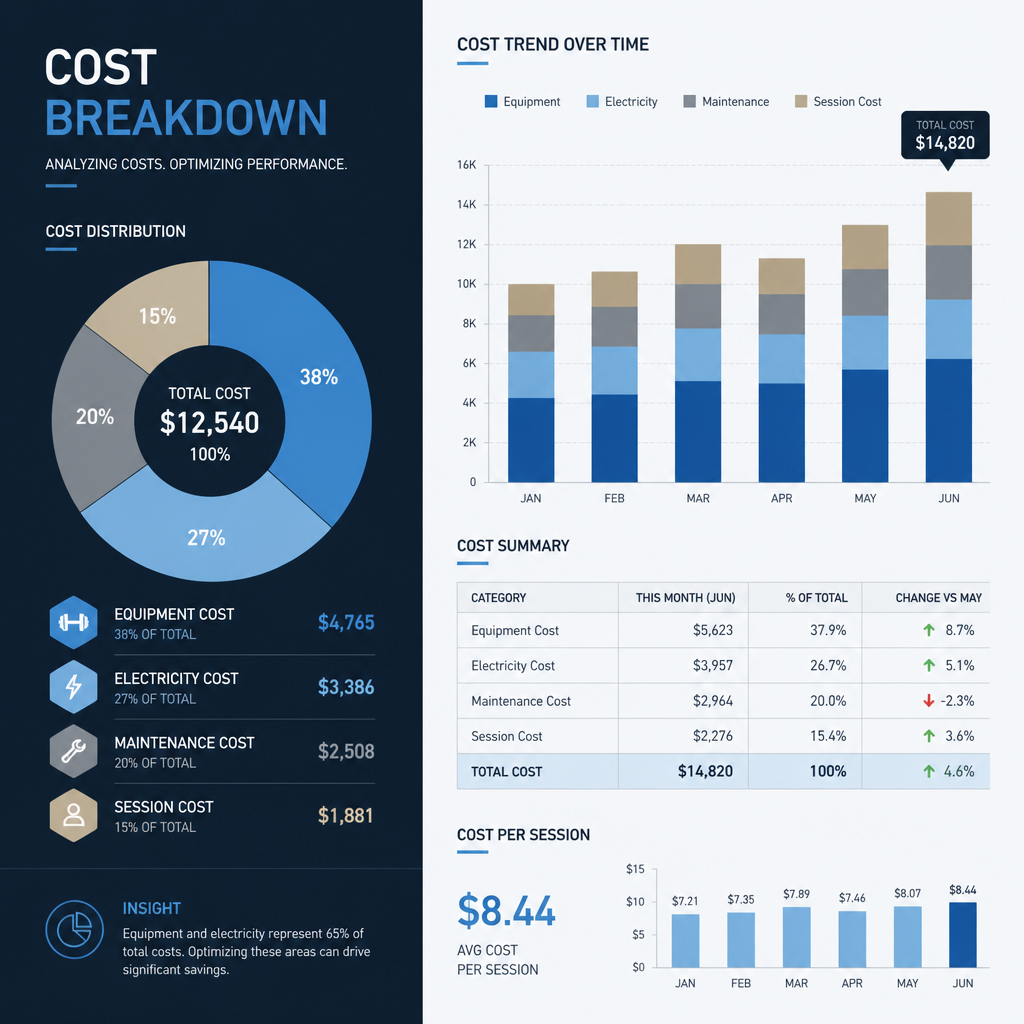
A properly sized home chiller paired with a well-insulated tub typically consumes between 15 and 40 euros per month in electricity, depending on the ambient temperature, target water temperature, frequency of use, and the tub's insulation quality. For home users with daily use, the electricity cost tends to be on the lower end, between 10 and 20 euros per month, thanks to the thermal insulation effect that reduces compressor strain.
In clinics or studios where multiple users access the same equipment, the cost goes up slightly but is diluted across several paid sessions, making the return per session even more favorable from a business perspective.
Water Maintenance Cost
Water quality is a frequently overlooked factor. In systems without filtration, you need to change the water regularly, which incurs water costs and effort. With a filtration system, an ozone generator, or an integrated purifier, water changes become necessary only every 1 to 3 months, significantly reducing the costs and labor involved.
Descaling or water maintenance products cost, on average, between 10 and 20 euros per month, depending on the tub's volume and local water hardness. This is a real cost that must be included in the total calculation.
Equipment Maintenance
Quality chillers have long lifespans and require little maintenance. Periodic filter cleaning, checking connections, and annual compressor maintenance are the main points of care. In terms of cost, this item is marginal if the equipment is of proven quality. Cheap equipment from unknown brands has a history of premature failures that can more than double the total cost of ownership in the long run.
Tip: A reusable washable filter saves dozens of euros per year on consumables and reduces the tub's maintenance time to less than 10 minutes per week. When evaluating tubs, check if the included filtration system is washable or requires periodic replacement.
Actual Cost per Session Over Time
The best way to evaluate an investment in a home ice bath is to calculate the cost per session over a 12- and 24-month horizon. This exercise completely changes the perspective on what is expensive and what is cheap.
Scenario with Portable Tub and Purchased Ice
Assuming a 200-euro portable tub and 3 weekly sessions, the cost of ice per session to maintain the appropriate temperature can easily reach 5 to 10 euros, depending on the local price of ice. In 12 months, with 3 sessions per week, you accumulate about 150 sessions. The ice cost alone can total between 750 and 1,500 euros, more than double the cost of the tub itself. After one year, the total cost can exceed 1,700 euros without having any temperature control or water filtration system.
Scenario with Tub and Home Chiller
With an initial investment of, for example, 1,800 euros in a complete system with a tub and mini chiller, monthly operating costs range between 20 and 40 euros (electricity plus maintenance). In 12 months, at 3 sessions per week and 40 euros of monthly costs, the total accumulated cost after one year is approximately 2,280 euros. Dividing by the 150 sessions conducted, the cost per session is about 15 euros in the first year. In the second year, without equipment amortization costs, the cost per session drops to less than 3 euros.
Cost of a Session at an External Clinic
A cryotherapy session at a clinic or wellness center in Portugal often costs between 30 and 80 euros, not counting travel time. For those who practice 3 to 4 times per week, this cost adds up to between 360 and 960 euros per month. The comparison with a home system becomes irrefutable after a few months of regular use.
The cost per session of a home system with a chiller and regular use of 3 times per week drops to less than 3 euros by the end of the second year. No clinic or recovery center can compete with that value per session.
Comparison Between Setups
The following table compares the three main approaches to having immersion cryotherapy at home, based on real costs and the practical characteristics of each.
| Setup | Estimated Initial Cost | Monthly Operating Cost |
|---|---|---|
| Portable tub + purchased ice | 80 to 400 euros | 60 to 150 euros (ice + water) |
| Portable tub + mini chiller | 1,000 to 2,500 euros | 20 to 40 euros (electricity + maintenance) |
| Professional integrated system + high-power chiller | 2,500 to 5,000+ euros | 25 to 50 euros (electricity + maintenance) |
The monthly operating cost column is frequently underestimated at the time of purchase. Those who opt for the cheapest solution at the beginning often end up paying more over 12 months than those who opted for a chiller system from the start.
The ROI of an At-Home Ice Bath
The return on investment in home cryotherapy has two dimensions. The financial dimension is the easiest to calculate and has already been demonstrated above. The performance and wellness dimension is what weighs most in the decision for those who already have experience with cold water immersion.
Financial ROI: When the System Pays for Itself
For an athlete or enthusiast who would use clinical cryotherapy 3 times a week at 40 euros per session, the monthly cost would be around 480 euros. A complete home system with a chiller, at an initial cost of 2,000 euros and 35 euros in monthly operations, hits the break-even point in less than 5 months. From that point on, each session represents real savings compared to the external alternative.
Even for those who would not use external services regularly, the comparison with other recovery investments, such as regular massages, compression equipment, or preventative physical therapy, makes the ice bath one of the most cost-effective options per session in the long run.
ROI in Performance and Consistency
Having an immersion system at home eliminates the main reason why most people don't maintain the practice: inconvenience. When the process requires booking an appointment, traveling, waiting, and paying per session, frequency drops. When the system is at home, consistency naturally rises.
Existing research suggests that distributing about 11 minutes of deliberate cold exposure per week across several sessions brings concrete benefits in muscle recovery and general wellness. Reaching this weekly volume is much easier with a home system accessible at any time of day.
The consistency benefit is hard to quantify in euros, but every athlete knows what it represents: fewer days of prolonged recovery, more quality training sessions, and lower risk of overuse injuries.
ROI in a Commercial Context
For gyms, hotels, physical therapy clinics, or wellness studios, the calculation is even more direct. A professional system like those offered by Alaska Recovery for commercial spaces can be amortized in a few months with just a few paid sessions per day. The differentiation that a premium recovery area offers a commercial space in terms of customer retention and market positioning goes far beyond the direct financial return per session.
Most Common Mistakes When Calculating Cost
In practice, most people who evaluate the cost of an ice bath at home make the same reasoning errors. Identifying them before buying can save hundreds or even thousands of euros.
Ignoring the Opportunity Cost of Ice
Those who buy a cheap tub without a chiller tend to underestimate the cost and hassle of maintaining the temperature with ice. Buying ice regularly is not only expensive, it is impractical. On hot days, the ice melts faster and the temperature rises before the session ends. The experience degrades, frequency of use drops, and the equipment goes unused. This cycle is more common than people think.
Not Counting the Water Maintenance Cost
A tub without an adequate filtration system requires changing the water very frequently. The cost of water, cleaning products, and the time spent are real. A system with a washable filter and an ozone generator significantly reduces this cost and makes daily use much more convenient.
Buying Based on Initial Price and Not Total Cost
This is the most common and expensive mistake. A tub at 150 euros plus 100 euros a month in ice costs over 1,300 euros in the first year. A system with a chiller at 2,000 euros plus 35 euros a month costs 2,420 euros in the first year, but only 420 euros in the second. After two years, the chiller system is cheaper. After three, the difference is several thousand euros in favor of the higher initial investment.
Underestimating the Impact of Thermal Insulation
A poorly insulated tub forces the chiller to work harder, consumes more electricity, and struggles to reach low temperatures in hot environments. Thermal insulation is not a comfort detail. It is a technical feature that directly affects monthly operating costs and compressor durability.
Frequently Asked Questions
What is the minimum cost to have a temperature-controlled ice bath at home?
The minimum cost for a chiller-controlled system starts around 1,000 to 1,500 euros for a setup with a portable tub and an entry-level mini chiller. Below that, you are dependent on ice, which is less practical and more expensive in the medium term. If the goal is consistent and frequent use, this is the minimum investment that makes sense to consider.
How much does the electricity for a home chiller cost per month?
For a home user with regular use and a well-insulated tub, the electricity cost for a chiller typically ranges between 15 and 40 euros per month. Chillers well-sized for the tub's water volume and used with an insulating lid consume less and maintain the temperature with less effort.
How quickly does a home ice bath pay for itself?
It depends on the alternative you compare it to. For someone who would use external cryotherapy sessions 3 times a week at 40 euros per session, a 2,000-euro home system can reach the break-even point in less than 5 months. For less intensive use, the return horizon is naturally longer, but the convenience and consistency of use also have real value that should be factored into the equation.
What is the cost difference between an ice tub and a chiller tub?
In the first year, the total cost difference may be small or even favorable to the chiller tub, depending on usage frequency. From the second year onwards, a chiller system is systematically cheaper because it eliminates the recurring cost of ice. In the long run, the accumulated difference can easily exceed 1,000 euros in favor of the chiller system.
Can I use an ice bath every day?
You can, but available research suggests that frequent, shorter-duration sessions spread throughout the week are more effective than single, long sessions. A frequency of 3 to 5 times per week is considered adequate for most athletes and fitness enthusiasts. For recovery after very intense training, it may make sense to use it more frequently during specific training load periods.
Is a home ice bath cheaper than sessions at a gym or clinic?
Yes, starting from a certain volume of use. For those who train more than 2 times a week, a home system starts to be financially more advantageous compared to paid sessions elsewhere. For very sporadic use, paying per session may be more efficient. The financial tipping point usually occurs between 4 and 8 months of regular use for investments in the 1,500 to 2,500 euro range.
What maintenance costs should I not ignore?
The main ones are: water maintenance products or filter replacements (10 to 20 euros per month), periodic chiller cleaning, and eventual replacement of wear parts over the years. With quality equipment and regular maintenance, these costs are predictable and low. The most common mistake is buying cheap equipment that breaks early and requires repairs or total replacement, nullifying all initial savings.
Do you already have an ice bath at home or are you considering the investment? Tell us your experience or your questions in the comments; your perspective helps other athletes make better decisions.
References
- Detailed cost analysis of a home cold plunge by configuration type
- Honest guide to cold plunge costs and value: is it worth the investment?
- How much electricity does a home cold plunge chiller use? Real electricity costs
- Complete guide to ice bath recovery: frequency, benefits, and costs
- How often should you take an ice bath for optimal benefits?